


Do Urban Trees Reduce Heat and Increase Property Values?

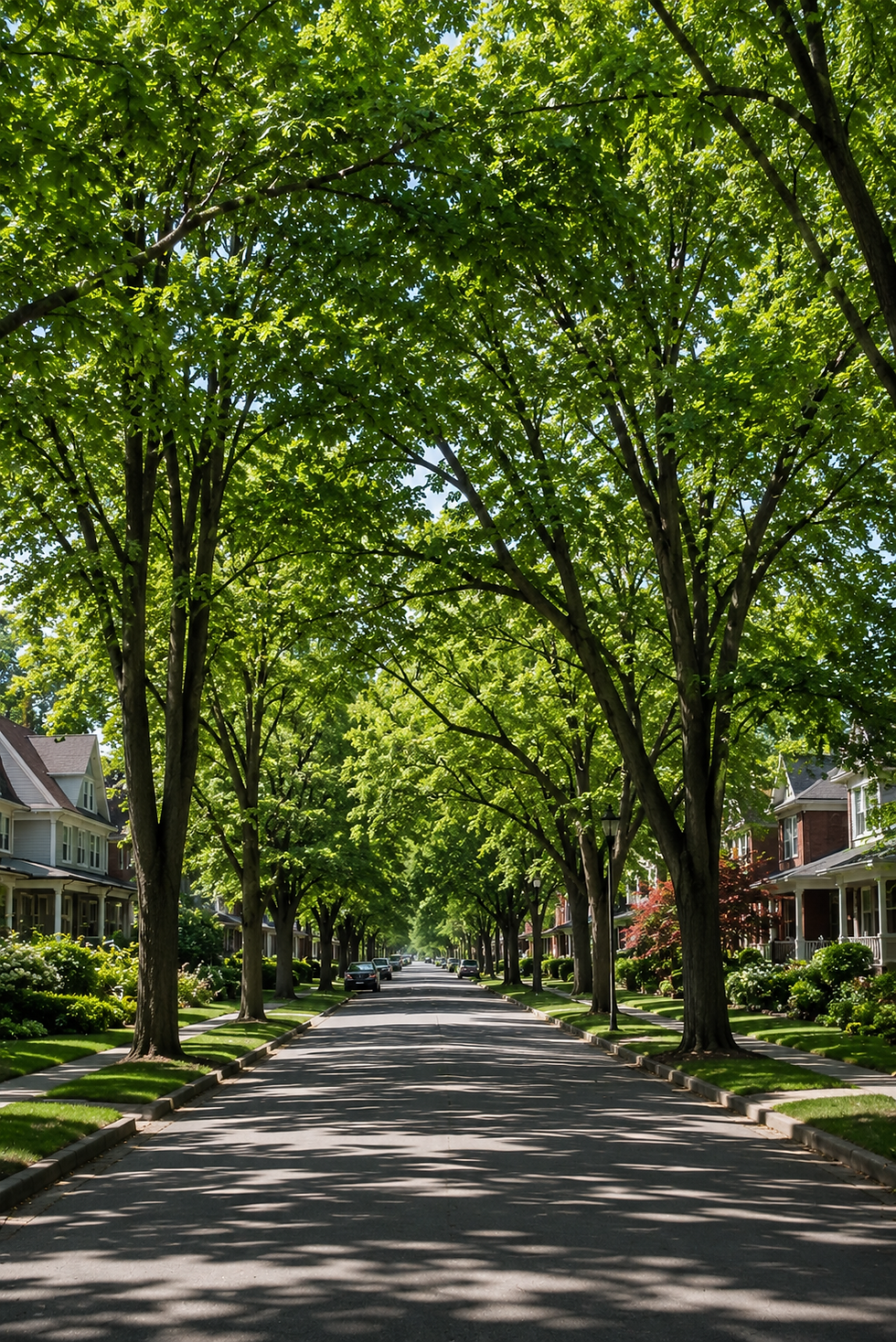
Han, Heblich, Timmins, and Zylberberg (2025) examined whether urban trees increase property values and reduce heat, pollution, and energy use in cities. They analyzed detailed land-cover data, satellite temperature records, energy consumption data, pollution measures, and more than 450,000 housing transactions in Toronto between 2007 and 2020. They used the spread of the invasive Emerald Ash Borer beetle, which killed large numbers of ash trees, as a natural experiment to measure the effects of tree loss. They found that a one-percentage-point increase in tree cover increased housing prices by 1.13%, lowered summer temperatures by 0.044°C, and reduced electricity use and air pollution exposure.
Why This Article Was Selected for The Policy Scientist
This article addresses an increasingly important policy issue as cities confront rising temperatures, denser development, and growing energy demands associated with climate change. Urban tree cover is often discussed in planning debates, but rigorous evidence about its measurable economic and environmental value has remained limited. Han, Heblich, Timmins, and Zylberberg make an important contribution by linking urban forestry to housing values, heat mitigation, pollution reduction, and energy consumption using a credible causal inference design rather than simple cross-sectional regression. The timing is especially relevant given current concerns about urban heat islands and infrastructure resilience. The authors have published extensively in urban and environmental economics, and this study builds on a broader literature examining environmental amenities and housing markets. The dataset is unusually strong, combining satellite imagery, land-cover assessments, pollution measures, energy records, and hundreds of thousands of housing transactions. While Toronto has unique characteristics, the findings are likely informative for many large metropolitan areas facing similar climate and development pressures. The instrumental-variable strategy based on the Emerald Ash Borer infestation substantially strengthens the credibility of the findings.
Full Citation and Link to Article
Han, L., Heblich, S. H., Timmins, C., & Zylberberg, Y. (2025). Cool cities: The value of urban trees. American Economic Review: Insights. Advance online publication. https://doi.org/10.1257/aeri.20240649
Central Research QuestionHan, Heblich, Timmins, and Zylberberg examine a central question in urban and environmental economics: what is the economic and environmental value of urban trees? More specifically, they investigate whether increases in urban tree canopy raise residential property values while simultaneously reducing urban heat exposure, energy consumption, and air pollution. The article responds to a longstanding empirical problem in the literature. Although urban planners and environmental researchers frequently argue that urban forests generate substantial public benefits, it has been difficult to estimate these benefits credibly because tree placement is not random. Wealthier neighborhoods may have more trees and better amenities simultaneously, making simple correlations unreliable. The authors therefore seek to isolate the causal effect of urban trees by exploiting a quasi-experimental shock created by the Emerald Ash Borer infestation in Toronto, which destroyed large numbers of ash trees across neighborhoods with differing levels of exposure.
Previous LiteratureThe article builds upon several overlapping literatures in urban economics, environmental economics, climate adaptation, and hedonic housing valuation. Earlier research demonstrated that environmental amenities such as parks, water access, views, and green space are capitalized into housing prices. Prior studies also suggested that trees reduce temperatures, improve air quality, lower stormwater runoff, and enhance neighborhood aesthetics. However, much of this earlier work relied heavily on cross-sectional regression analysis, leaving estimates vulnerable to omitted variable bias and reverse causality.
The authors position their study as part of a newer generation of environmental economics research that attempts to identify causal relationships using natural experiments or quasi-experimental variation. In particular, they reference studies examining invasive species, forest diseases, and ecological disruptions as sources of exogenous environmental change. The paper also contributes to research on urban heat islands and climate adaptation strategies. This literature has become increasingly important as cities face rising temperatures associated with climate change and continued urbanization.
The study connects especially closely to prior work estimating the hedonic value of urban forestry, but it distinguishes itself by combining unusually detailed spatial data with an instrumental-variable strategy. The article also extends earlier research examining the Emerald Ash Borer infestation by linking tree loss not only to housing values, but also to temperature, energy use, and pollution outcomes. In doing so, the authors move beyond purely aesthetic interpretations of urban trees and frame urban forestry as a form of climate infrastructure with measurable economic returns.
DataThe dataset assembled for the study is unusually comprehensive and represents one of the paper’s major strengths. The authors combine multiple forms of spatial, environmental, and economic data covering Toronto between roughly 2002 and 2020. Their primary geographic unit is the postal code, which in Toronto typically contains about twenty households. This high level of spatial resolution allows the authors to measure neighborhood-level variation with considerable precision.
The study incorporates detailed land-cover assessments conducted by the City of Toronto in 2007 and 2018 using satellite imagery, LiDAR data, and manual verification. These assessments distinguish tree canopy from roads, buildings, grass, paved surfaces, and other land uses. The authors supplement these data with annual satellite-based vegetation indices from Landsat and Sentinel imagery in order to track changes in urban forestry over time.
The article also relies on an extensive registry of publicly managed trees maintained by the City of Toronto. This database identifies approximately 600,000 city-managed trees, including roughly 45,000 ash trees vulnerable to the Emerald Ash Borer infestation. These records allow the authors to estimate each neighborhood’s initial exposure to tree loss before the infestation spread widely.
Housing market data are equally detailed. The authors analyze approximately 457,000 residential property transactions occurring between 2007 and 2020. These records include information about sale prices and property characteristics such as dwelling type, number of bedrooms, and size. The paper further integrates residential electricity and gas consumption data from approximately 800,000 meters, fine particulate pollution estimates, and satellite-derived land surface temperature measures. The breadth and integration of these datasets substantially strengthen the study’s empirical credibility.
MethodsThe methodological design of the paper represents one of its most important contributions. Rather than relying on conventional multivariate regression alone, the authors employ a causal inference framework using an instrumental-variable strategy. Their identification approach exploits the Emerald Ash Borer infestation as a plausibly exogenous environmental shock.
The Emerald Ash Borer is an invasive beetle species that selectively kills ash trees. Because different Toronto neighborhoods had varying concentrations of ash trees prior to the infestation, some areas experienced much larger declines in tree canopy than others. Crucially, the infestation itself was not driven by local housing prices or neighborhood demand conditions. The authors therefore use the pre-existing density of ash trees as an instrument for subsequent changes in tree canopy.
The study primarily uses a long-difference framework comparing conditions before and after the infestation. The baseline specification compares housing prices between pre-treatment years (2007–2008) and post-treatment years (2016–2020). The authors control extensively for housing characteristics, geography, land-use composition, and neighborhood fixed effects.
The article also includes event-study analyses to test whether property value trends diverged before the infestation occurred. These analyses strengthen the argument that the observed housing price changes were associated with tree loss rather than pre-existing neighborhood trajectories. Additional robustness checks examine alternative timing assumptions, alternative specifications, and placebo tests using other tree species.
The statistical approach is considerably stronger than much of the earlier urban forestry literature because it directly addresses endogeneity concerns. While the design does not achieve the internal validity of a randomized controlled trial, the quasi-experimental framework substantially improves causal interpretation relative to standard hedonic regressions.
Findings/Size EffectsThe paper reports substantial economic and environmental effects associated with urban tree canopy. The authors estimate that a one-percentage-point increase in tree cover raises property values by approximately 1.13 percent. This represents a sizable capitalization effect relative to many earlier estimates in the literature.
The effects of large-scale tree loss are particularly notable. Neighborhoods with high initial ash-tree density experienced approximately seven-percentage-point declines in tree canopy following the infestation. According to the authors’ estimates, this translated into housing price declines approaching 8 percent in the most affected areas.
The study also finds meaningful environmental effects. A one-percentage-point increase in tree cover reduced summer land surface temperatures by approximately 0.044 degrees Celsius. Areas heavily affected by the infestation experienced warming of roughly 0.30 degrees Celsius during summer months. Although this temperature effect may appear modest numerically, it is substantial within dense urban environments where even small increases in heat exposure can affect energy demand and public health.
Urban trees also reduced electricity consumption. The authors estimate that a one-percentage-point increase in tree cover lowered summer electricity use by approximately 0.49 percent. Tree cover additionally reduced fine particulate matter pollution concentrations during summer months. While the pollution effects were smaller than the housing price effects, they remained statistically significant.
The article further identifies nonlinearities in valuation. The marginal value of additional trees was higher in neighborhoods that already possessed relatively dense tree cover. This suggests that urban forestry benefits may compound spatially, potentially contributing to unequal distributions of green infrastructure across cities.
ConclusionThe article provides some of the strongest causal evidence to date regarding the economic and environmental value of urban trees. By combining detailed spatial data with a quasi-experimental identification strategy, the authors demonstrate that urban forestry generates measurable benefits in housing markets, temperature regulation, energy consumption, and pollution reduction.
The study is particularly important because it reframes urban trees not simply as aesthetic amenities, but as functional climate infrastructure within increasingly dense and warming metropolitan areas. The findings suggest that urban forestry may represent a relatively cost-effective adaptation strategy as cities confront rising temperatures associated with climate change.
The paper also advances the methodological standards of the urban forestry literature. Earlier studies often relied on simple correlations between green space and housing prices. By contrast, this article uses a credible causal inference framework that substantially strengthens confidence in the estimated effects. Although the study focuses on Toronto, its findings are likely relevant to many large North American metropolitan areas with similar urban development patterns and climate pressures.
More broadly, the article demonstrates how ecological disruptions can serve as valuable natural experiments for understanding the economic consequences of environmental change. In doing so, it contributes not only to urban economics and environmental policy research, but also to the growing literature examining climate adaptation and urban resilience.


Comments