


How Do Wars Affect Economic Outcomes?

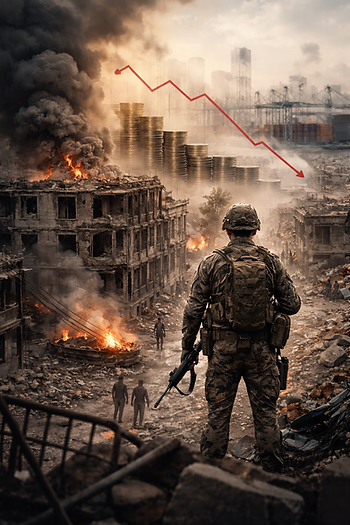
Federle et al. (2025) ask how wars affect economies in the country where fighting occurs and in nearby or connected countries. They assemble a new 150-year, 60-country dataset containing macroeconomic indicators and war casualty data. They find that an average-intensity war causes output in the war-site economy to fall by about 10 percent, consumer prices to rise roughly 20 percent, and capital stock and productivity to decline. They also show that countries trading with the war site experience spillovers, with output falling about 2 percent. They conclude that war produces large economic losses at home and meaningful recessionary effects abroad.
Why This Article Was Selected for The Policy Scientist
This article addresses a consequential topic: the economic repercussions of war. The importance is broad because war remains a persistent feature of the international system, and the macroeconomic channels they document—trade exposure, supply shocks, price dynamics—have direct relevance for today’s geopolitical environment. It is timely given rising conflict risk and global economic fragmentation. The authors have written extensively in this field, and this study contributes by combining a long-run, multi-country dataset with systematic macro evidence. The data are unusually rich and well constructed, enhancing external validity across jurisdictions. Methods are descriptive rather than causal; future work would benefit from causal identification.
Full Citation and Link to Article
Federle, J., Meier, A., Müller, G. J., Mutschler, W., & Schularick, M. (2025). The price of war. American Economic Review. https://doi.org/10.1257/aer.20241355.
Central Research Question
Federle et al. (2025) examine whether, and to what degree, wars generate persistent macroeconomic losses in the countries where fighting occurs and whether these losses spill over to other belligerent and third-party countries that are economically or geographically connected to the war site. They seek to quantify the magnitude, duration, and channels of these effects rather than test a micro-level mechanism. The authors primarily ask three interrelated questions: (1) How large are the output, inflationary, capital, and financial market consequences of wars for countries directly experiencing military action? (2) Do connected countries—either co-belligerents or non-belligerent third parties—experience measurable economic spillovers? (3) To what extent are these effects driven by trade exposure and border adjacency? While the authors refrain from asserting strict causality for most specifications, their research question is inherently macroeconomic, historical, and descriptive, focusing on durable empirical regularities rather than theory testing.
Previous Literature
The study situates itself at the intersection of several strands of empirical macroeconomic and political economy research. First, it connects to work quantifying the macroeconomic costs of war, especially those focusing on major 20th-century conflicts (e.g., Barro, 2006; Broadberry & Harrison, 2005; Davis & Weinstein, 2002). That literature demonstrates high output losses and capital destruction during large interstate wars but mostly focuses on single conflicts or single countries. Second, the study relates to research on civil wars and political instability, including Cerra and Saxena (2008), who found persistent output losses after civil wars, and Acemoglu, Johnson, and Robinson (2005), who linked conflict to institutional decay. Third, it connects to research on trade disruptions and geopolitical risk, including Glick and Taylor (2010), Qureshi (2013), and Caldara and Iacoviello (2022), which show how conflicts impair international trade and shift expectations. Fourth, a smaller strand investigates how military mobilization and fiscal expansion during wars affect macroeconomic aggregates, including work by Ramey and Shapiro (1998) and Ilzetzki (2024). Finally, the authors acknowledge research in international political economy linking trade integration to conflict probabilities (e.g., Martin, Mayer, & Thoenig, 2008). Federle et al. contribute by linking these strands: they cover a much broader set of wars, introduce a consistent cross-national macro dataset spanning 150 years, emphasize spillovers, and bring together micro-founded trade exposure metrics with aggregate macro outcomes.
Data
The authors compile a new dataset from 1870–2023 for 60 countries, linking macroeconomic time series to newly geocoded measures of war intensity. The macro data derive primarily from the Jordà-Schularick-Taylor Macrohistory Database, extended through 2023 using Funke, Schularick, and Trebesch (2023). Variables include real GDP, CPI, capital stock, total factor productivity (TFP), equity returns, long-term interest rates, military spending, and military personnel. War data originate from the Correlates of War (COW) project, augmented with battle-level geolocation drawn from historical sources such as Clodfelter (2017), including casualty counts for each battle. Casualties are aggregated to present-day territorial definitions to ensure statistical compatibility with macro series. War intensity is measured as total battle casualties divided by the war-site country’s pre-war population. For interstate wars, the dataset includes 225 country-year onsets; for intrastate and extrastate wars, 469 additional onsets. The authors also incorporate bilateral trade data from Fouquin and Hugot (2016), using gravity-based missing data imputation. Institutional variables—media freedom, judicial independence, electoral fairness—are sourced from Varieties of Democracy (V-Dem). This dataset is unusually rich in temporal and geographic scope and allows the authors to characterize both domestic and international effects. Because data rely on present-day borders and modern territorial accounting, comparability across cases is improved, though this choice sacrifices some granularity for historical empires. Coverage is unbalanced across variables but sufficient to estimate dynamic responses over at least eight post-onset years for most macro variables.
Methods
The authors estimate dynamic responses using Jorda-style (2005) local projections, modeling outcomes for war sites, belligerents, and third countries separately. Dynamic treatment corresponds to the war onset in a specific country-year, scaled by intensity. The regressions include country fixed effects, lags of dependent variables, and exposure vectors capturing either trade flows or adjacency. Dynamics are estimated for horizons up to eight years after onset, with confidence intervals based on Driscoll-Kraay standard errors to address serial and cross-sectional dependence. Spillovers are estimated using exposure-weighted war intensity, with exposure measured via bilateral imports from the war site (pre-onset) as a share of GDP and via border adjacency. The authors describe their main results as non-causal due to endogeneity risk, but they add a restricted sample of interstate wars that are narratively coded as exogenous to short-run economic conditions to approximate causal interpretation. They test pre-trends to detect whether wars are forecastable from inflation and output dynamics and find that civil wars display pre-trends whereas interstate wars generally do not. When dropping interstate wars with short-term economic motivations (six cases), the main estimates remain similar, which the authors interpret as suggestive—but not definitive—evidence of causal effects.
Findings/Size Effects
Results show that in an average-intensity conflict, war-site GDP falls approximately 10 percent below trend four years after onset, with slow recovery extending beyond a decade. CPI rises around 20 percent above trend, suggesting war operates partly as a supply shock. Capital stock falls by more than 4 percent within eight years, and TFP declines sharply early in the conflict. Long-term interest rates rise by about 0.3 percentage points and remain elevated for years. Equity markets in war sites exhibit cumulative underperformance of roughly 20 percent within six years. Military spending increases by up to 2.5 percentage points of GDP, and military personnel increase by nearly one percent of population during peak years. Spillovers occur through trade exposure: third countries importing goods equal to 3 percent of GDP from the war site experience output declines of roughly 2 percent and inflationary pressure, while equity returns weaken. Belligerents display milder effects; output does not contract on average, consistent with fiscal-military mobilization offsetting trade-related recessionary forces. Trade volumes contract for war sites (approximately 3 percentage points of GDP for both imports and exports), and exposed third countries face shrinking trade flows. Institutional variables worsen in war sites: media freedom, judicial independence, and electoral fairness decline persistently; media freedom also declines somewhat in belligerents. Interstate and civil wars differ: the former produce larger macroeconomic effects, while the latter display stronger pre-trends and likely endogeneity. Overall, the study documents quantitatively large, long-duration macroeconomic and institutional consequences that extend beyond national borders.
Conclusion
Federle et al. demonstrate that wars impose sizable and persistent economic costs on directly affected countries and meaningful spillovers on other nations via trade and geographic channels. Their results show that macroeconomic disruptions are not confined to rare global wars, but emerge across a wide range of conflicts from 1870 to the present. The implications are broad: in an era of geopolitical fragmentation, war operates as a recurrent supply-side shock with international transmission. Their dataset enables new stylized facts rather than fine-grained causal inference; however, narrative evidence for interstate wars suggests limited pre-onset bias for many cases. The combination of long-run macro series, battle-level geocoding, and bilateral trade exposure represents a substantial empirical contribution and establishes a clearer quantitative baseline for how war affects modern economies.


Comments