


How Can Cobots Be Used to Complement Human Labor Rather Than Replace It?

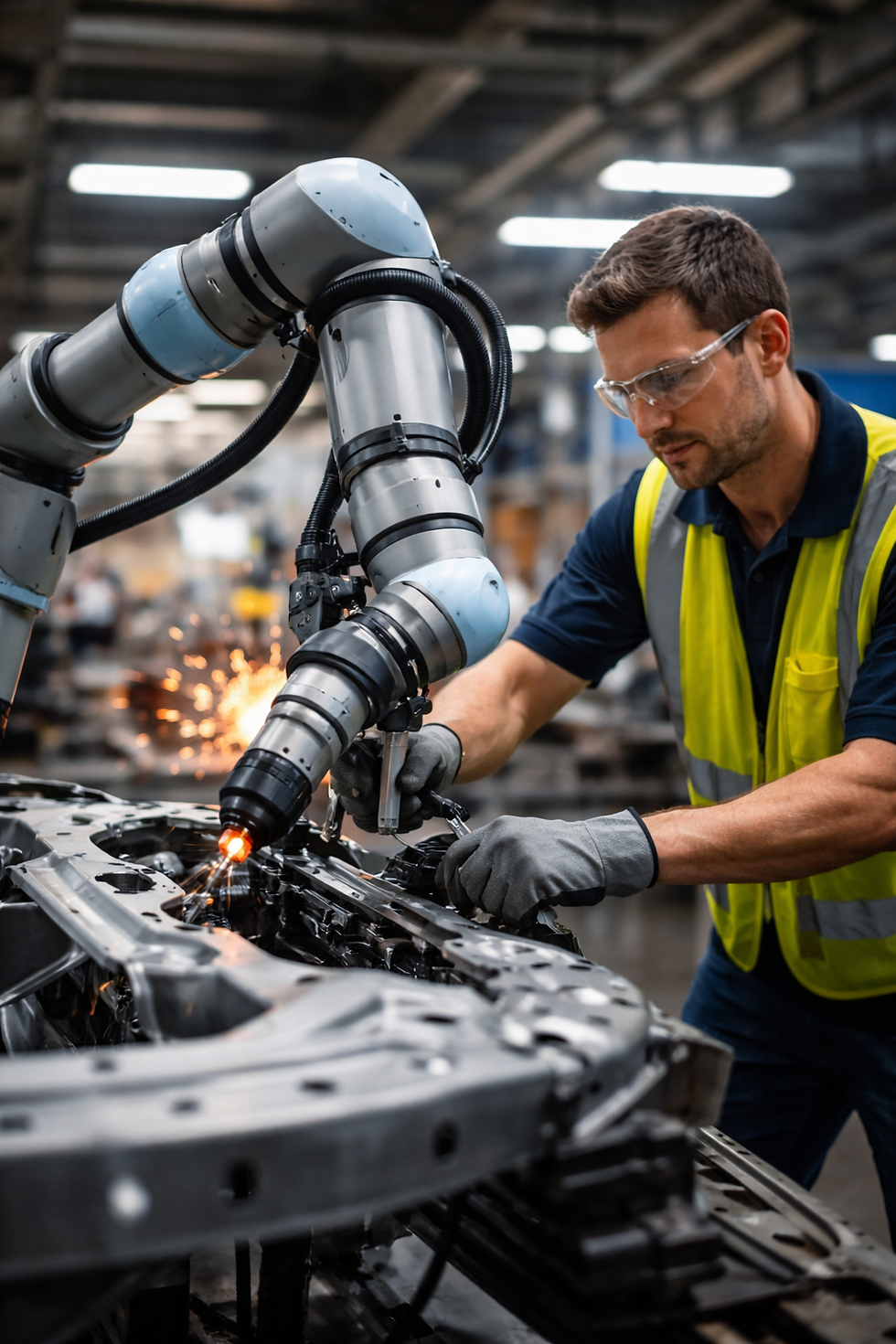
Jacobs et al. (2026) ask whether collaborative robots (cobots) can be used to raise productivity while preserving jobs, rather than displacing workers. They examine existing research, industry case examples, and prior empirical studies on automation, worker safety, ergonomics, and labor markets, rather than analyzing a new dataset. They find that cobots tend to automate specific tasks instead of whole jobs, reducing physical strain and workplace injuries while increasing output per worker. Prior studies they synthesize show meaningful declines in injury rates and fatigue and measurable productivity gains, especially in physically demanding manufacturing tasks, when cobots are designed to complement human labor rather than replace it.
Why This Article Was Selected for The Policy Scientist
This article addresses a central policy challenge: how advanced technologies can raise productivity without repeating the large employment disruptions associated with earlier waves of automation and trade shocks. The topic is especially timely given renewed domestic manufacturing investment, tighter labor markets, and rapid advances in robotics and AI. Jacobs and her coauthors have written extensively at the intersection of labor markets, technology, and inequality, and this piece synthesizes that body of work in a policy-relevant way. The article builds on highly cited research by Autor, Acemoglu, and Restrepo by emphasizing task-level complementarity rather than job-level displacement.
Full Citation and Link to Article
Jacobs, L. (2026). Cobots as workforce partners: Overcoming barriers to collaborative robot adoption and productivity enhancement. Journal of Policy Analysis and Management, 45(1). https://doi.org/10.1002/pam.70083
Central Research Question
The article asks whether collaborative robots, or cobots, can be integrated into manufacturing in ways that raise productivity while preserving employment, improving job quality, and avoiding the large-scale worker displacement associated with earlier waves of automation. Rather than treating automation as an inevitable substitute for labor, the authors focus on whether policy, institutional design, and task-level integration can steer technological change toward complementarity between humans and machines. The core question is not simply whether cobots increase output, but under what conditions their adoption can align firm incentives with broader labor market goals such as safety, wage stability, and career longevity. This framing shifts attention from technology alone to the policy environment that shapes how technology is deployed.
Previous Literature
The article builds on a large and influential literature on automation, trade, and labor markets, particularly work documenting how industrial robots and offshoring have contributed to job loss, wage polarization, and regional economic decline. Highly cited research by Autor, Acemoglu, and Restrepo emphasizes task substitution, declining labor shares, and uneven geographic impacts of automation. Other studies show that productivity gains from automation do not automatically translate into higher wages or better working conditions. Against this backdrop, a smaller but growing body of research in human–robot interaction and ergonomics has documented settings in which robots complement human labor by taking on physically demanding or repetitive tasks. The authors position cobots at the intersection of these literatures, arguing that they represent a technological category with different labor market implications than traditional industrial robots. Their contribution is to synthesize insights from economics, engineering, and occupational health to show how task design, worker input, and policy incentives can shape outcomes.
Data
The article does not introduce a new quantitative dataset or conduct original empirical analysis. Instead, it synthesizes evidence from prior empirical studies, industry case examples, administrative data analyses from the literature, and descriptive statistics on robot adoption, injury rates, and occupational exposure. The authors also draw on published estimates of robot exposure across industries, occupations, and geographic areas, including recent work mapping cobot-suitable tasks to worker demographics. In addition, they reference qualitative and experimental studies from engineering and human–robot interaction that examine worker acceptance, fatigue, and ergonomics in cobot-assisted environments. Because the article is a policy insight rather than an empirical paper, the data are secondary and illustrative rather than the basis for new causal estimates.
Methods
Methodologically, the article relies on narrative synthesis rather than formal statistical modeling. The authors integrate findings from observational labor economics studies, field experiments in ergonomics and human–robot interaction, and descriptive analyses of industrial investment and trade policy. They compare outcomes across different types of automation and across institutional settings, such as unionized versus nonunionized workplaces, to infer how policy and governance structures may mediate technology’s effects. While the article references studies using regression analysis, exposure indices, and quasi-experimental designs, it does not itself employ causal inference techniques or randomized controlled trials. Instead, it uses interdisciplinary reasoning to connect empirical findings from different domains and to identify mechanisms through which cobots may affect productivity, safety, and employment.
Findings/Size Effects
The central finding is that cobots tend to automate tasks rather than entire jobs, which distinguishes them from earlier forms of industrial automation. Evidence synthesized in the article suggests that cobots can meaningfully reduce physical strain and workplace injuries, particularly in physically demanding manufacturing roles. Prior studies cited by the authors show measurable declines in injury rates and fatigue when repetitive or heavy tasks are shifted to cobots, alongside increases in output per worker. Productivity gains appear to be positive but moderate, reflecting efficiency improvements at the task level rather than radical labor substitution. The authors also highlight evidence that worker acceptance is higher when employees have input into task allocation and when cobots are designed to be predictable and transparent. Distributional impacts are uneven: occupations with higher physical demands and lower wages are more likely to be exposed to cobot integration, while geographic impacts vary across regions with concentrated manufacturing activity. The size effects discussed are drawn from the existing literature rather than estimated directly, and they point to nontrivial but context-dependent benefits.
Conclusion
The article concludes that cobots represent a potentially important inflection point in the relationship between automation and labor, but only if policy actively shapes their adoption. The authors argue that without intervention, firms may still deploy cobots in ways that intensify work or displace labor, reproducing past patterns. They identify policy levers in training, tax incentives, occupational safety regulation, and worker voice that could encourage labor-augmenting uses of technology. While the article does not provide new causal evidence, it offers a coherent framework for understanding how cobots differ from traditional automation and why those differences matter for policy. The analysis would be strengthened by future research using causal inference or randomized field experiments to isolate the effects of cobot adoption on wages, employment, and safety. Nonetheless, the article makes a substantive contribution by integrating disparate literatures and by reframing automation policy around task design and institutional context rather than technological inevitability.


Comments